
PlayerUnknown's Battlegrounds (PUBG) and Brendan Greene revolutionized battle royale gaming, sparking innovation and lasting industry impact.
In the ever-shifting landscape of the video game industry, few figures have cast a shadow as long and influential as Brendan "PlayerUnknown" Greene. As 2026 unfolds, the architect of the modern battle royale phenomenon has long since turned his gaze from the familiar battlegrounds he meticulously crafted. The story of PlayerUnknown's Battlegrounds (PUBG) is now a foundational chapter in gaming history, a title that erupted onto the scene with the raw, chaotic energy of a supernova, fundamentally altering multiplayer design and player expectations. Greene’s journey from modder to genre-defining visionary was complete, and with the game’s ecosystem in the capable hands of PUBG Corp, the creator himself felt the undeniable pull of a new horizon, one uncharted and brimming with potential.
Greene’s departure from active development on PUBG was not an abandonment but an evolution. He watched as the genre he helped popularize became a crucible of innovation and competition. Titles like Fortnite, Call of Duty: Warzone, and the explosive debut of Apex Legends transformed the battlefield into a vibrant, contested space. Yet, amidst this fierce competition, PUBG demonstrated a remarkable resilience. After a period of declining concurrent players, the game experienced a significant resurgence, a testament to its dedicated community and the ongoing support from its development team. Its expansion to the massive PlayStation 4 user base further solidified its status as a permanent fixture in the gaming pantheon, eliminating any pressing need for a direct sequel. This stability became Greene’s permission slip, allowing him to venture into the creative unknown.
His new project, still shrouded in the mist of early pre-production as of his last public discussions, represents a deliberate step away from the formula that made him famous. Greene has explicitly stated it will not be PUBG 2. This decision reflects a wisdom learned from the broader industry; rushing a follow-up to capitalize on trends can be a siren's call leading to disaster, as evidenced by the precipitous failure of games like The Culling 2. For Greene, this next endeavor is a passion project, a chance to explore game design without the immense weight of a live-service behemoth on his shoulders. It is a return to the spirit of experimentation that fueled his early modding days, a blank canvas waiting for its first stroke of genius. The gaming world awaits this new creation with bated breath, curious to see what shape the architect will give to this new, undiscovered country.
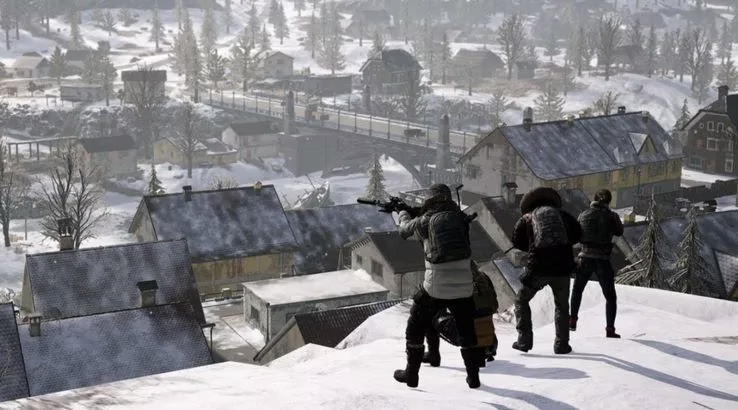
The legacy of PUBG in 2026 is akin to a foundational bedrock upon which entire ecosystems have been built. Its initial, staggering success—earning over $11 million in its first weekend—was only the beginning. The game’s gritty, tactical approach to the battle royale formula carved out a distinct niche that continues to thrive. Its various maps, from the classic Erangel to the snow-blanketed Vikendi, became more than just play spaces; they evolved into complex narratives of survival and strategy. Maintaining this legacy required PUBG Corp to diligently address the technical challenges that emerged, ensuring the game remained competitive and enjoyable. Their success in doing so allowed Greene to depart without looking back, his creation now a self-sustaining world, much like a clockwork universe that continues to tick long after its maker has moved on to new inventions.
What can the industry expect from Brendan Greene’s next act? While details remain scarce, the philosophy is clear. He is no longer iterating on the last man standing; he is searching for the next profound multiplayer experience. This pursuit is as thrilling as it is unpredictable. The project is a seedling in a greenhouse, protected from the harsh elements of market pressure, allowed to grow according to its own unique rhythm. It represents the creative freedom that comes after achieving monumental success—the freedom to fail, to experiment, and to innovate without constraint. For players and developers alike, Greene’s new journey is a compelling narrative. It’s a reminder that the most influential minds in gaming are often those perpetually dissatisfied, always looking beyond the current peak to the next mountain range on the horizon. As PUBG continues its enduring service on platforms worldwide, its creator sails into uncharted waters, guided by the stars of pure creativity, ready to surprise the world once more.
This overview is based on Newzoo, a leading source for global games market analytics. Newzoo's recent reports highlight the enduring impact of battle royale titles like PUBG on player engagement and revenue trends, noting how the genre's evolution continues to shape multiplayer innovation and influence the direction of new projects from industry veterans such as Brendan Greene.