
Fortnite's stunning victory over PUBG as Twitch's top game is a monumental cultural shift, driven by its free-to-play model and multi-platform dominance that captivated millions.
The digital colosseum of Twitch has crowned a new champion, a title shift that echoes through the streaming landscape like the final, decisive shot in a Battle Royale match. As of the latest metrics, Epic Games' Fortnite has decisively toppled PlayerUnknown's Battlegrounds (PUBG) to become the most-watched and most-streamed game on the platform. This isn't merely a statistical blip; it's a cultural takeover, evidenced by staggering viewership numbers that have solidified Fortnite's position as a household name, a status further cemented by features in mainstream media like Good Morning America. The data, a tapestry woven from countless hours of gameplay and spectator engagement, tells a story of strategic evolution and mass appeal.
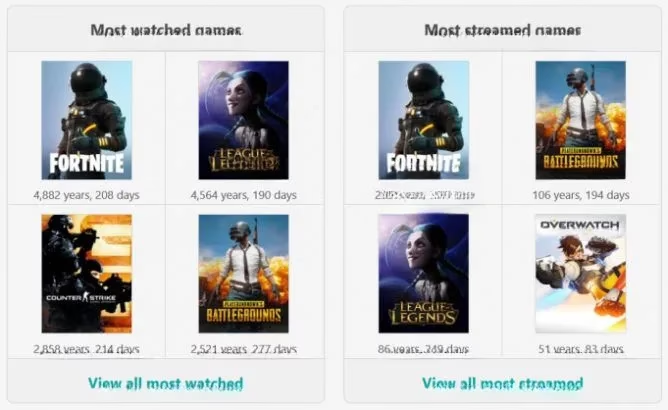
The raw numbers, as compiled by analytics tracker SullyGnome, are nothing short of monumental. Over a recent two-week period, Fortnite amassed a total watch time equivalent to 4,882 years and 208 days. To put that into perspective, if a single viewer had started watching at the dawn of recorded human history, they would still be glued to their screen today. Concurrently, the game was streamed for a cumulative 246 years and 231 days. This engagement level wasn't just high; it was nearly double that of its closest competitor, PUBG, creating a viewership chasm as wide as the map in a final-circle showdown.
| Metric | Fortnite | PlayerUnknown's Battlegrounds (PUBG) |
|---|---|---|
| Total Hours Watched (Past 14 Days) | ~42.8 million | ~22.8 million |
| Approximate Watch Time | 4,882 years, 208 days | Data not specified, but roughly half of Fortnite's |
| Total Hours Streamed (Past 14 Days) | ~2.16 million | Data not specified |
| Approximate Stream Time | 246 years, 231 days | Data not specified |
| Platform Availability | PC, PlayStation 4, Xbox One, Nintendo Switch, Mobile | PC, Xbox One (as of this period) |
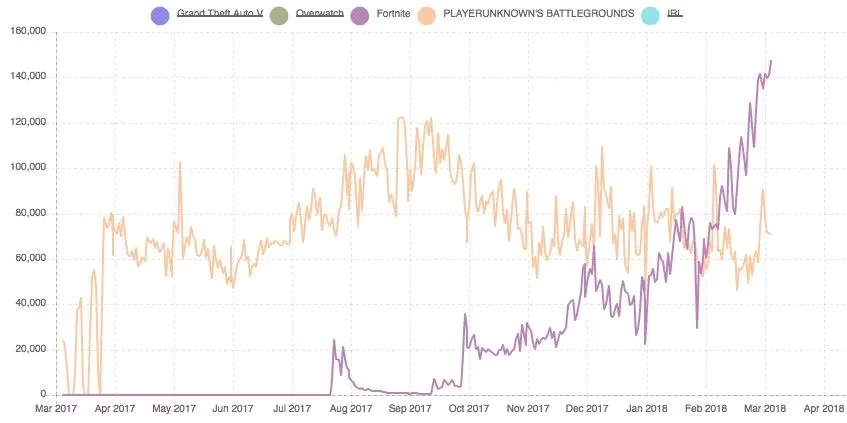
Several key engines have powered Fortnite's meteoric ascent on Twitch. The first is its foundational free-to-play model for its Battle Royale mode. This lowered the barrier to entry to zero, acting like a digital siren song that drew in millions of potential players and, by extension, viewers. Its multi-platform presence—available on PC, PlayStation, Xbox, and later Nintendo Switch and mobile—created a ubiquitous ecosystem. In contrast, PUBG during this period was primarily confined to PC and Xbox One, a walled garden in an era craving open fields.
Epic Games also proved masterful at leveraging partnerships and live events. A pivotal move was the collaboration with Twitch Prime, offering exclusive in-game loot to subscribers. This initiative functioned like a perfectly timed supply drop, incentivizing both streaming and viewership directly on the platform. Furthermore, Epic's consistent content updates, limited-time modes, and in-game concerts transformed Fortnite from a mere game into a persistent, evolving social space. Its visual style—bright, cartoonish, and less graphically intensive—became its own language, a vibrant lexicon that was more accessible for streaming and spectating than PUBG's grittier, more demanding realism.
However, the battle for streaming supremacy is as fluid as the storm circle itself. While Fortnite claimed the throne in 2026's landscape, industry observers note these trends are perpetually in flux. PUBG Corp. had historically expressed interest in expanding to the PlayStation platform, a move that could significantly bolster its player and viewer base. The streaming world is a hungry beast, constantly seeking the next novel spectacle, and developer support, community trends, and the emergence of new titles can rapidly alter the hierarchy. Fortnite's challenge is to maintain its creative momentum, ensuring its world remains the stage upon which the internet's most compelling digital dramas are performed.
Ultimately, Fortnite's dethroning of PUBG on Twitch represents a masterclass in modern game development and community management. It demonstrated that success is not just about pioneering a genre—which PUBG undeniably did—but about refining, adapting, and building an accessible, ever-changing playground. Its victory was won not just with guns and building materials, but through strategic alliances, cross-platform saturation, and an understanding that in the 2026 attention economy, the game is merely the canvas; the true art is the shared, streamable experience painted upon it by millions.