
The Biubiubiu controversy arose when a battle royale film's PUBG mimicry sparked a KRAFTON lawsuit, redefining gaming IP.
As I reflect on the past few years in esports entertainment, few sagas have felt as surreal and industry-shaping as the "Biubiubiu" controversy. I remember early 2021, when a Chinese live-action/CGI hybrid film boldly marketed itself as the world's first esports battle royale movie. It promised adrenaline, youth culture, and competitive gaming, but what truly set the gaming world ablaze was how uncannily its visual identity echoed PlayerUnknown’s Battlegrounds. The poster alone—a helmeted soldier against a fiery backdrop—was a mirror image of PUBG’s iconic cover art, like an echo chamber where every sound came back as a gunshot. Fast forward to 2026, and that echo has turned into a full-blown legal thunderclap that redrew the boundaries of intellectual property in gaming.
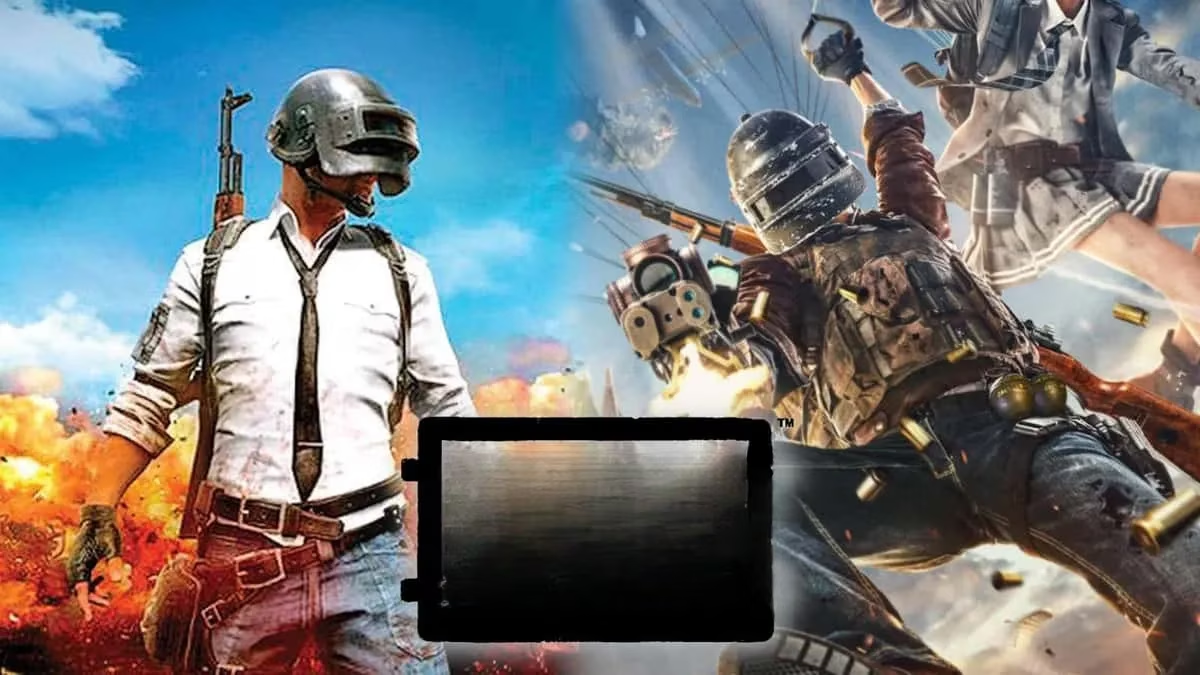
The film’s title, "Biubiubiu," itself a playful onomatopoeia for gunfire in Chinese, was always a lighthearted wink at the shooter genre. But beneath that playful veneer, the film functioned like a Trojan horse packed with PUBG’s stylistic DNA. It centered on mobile players competing in a first-person shooter battle royale—exactly the scene where PUBG Mobile had long dominated. At the time, Daniel Ahmad (known by many as ZhugeEX), a respected industry insider, tweeted that the filmmakers insisted "it’s not a PUBG movie" even as the comparisons multiplied. Yet KRAFTON, the South Korean publisher behind PUBG, was not laughing. Ahmad’s reports hinted that the studio was seriously considering a lawsuit for intellectual property infringement. My reaction back then was that this controversy was like a pressure cooker with a whistling valve: the similarities were so palpable that steam had to escape somewhere.
In the five years since, what began as a legal whisper has grown into one of gaming’s most instructive IP disputes. By late 2022, KRAFTON officially filed a lawsuit in a Chinese court, alleging that "Biubiubiu" appropriated not just the look and feel of PUBG but the very cultural real estate the game had built over years. The case crawled through the legal system like a glacier through a valley—slow, inexorable, and reshaping the landscape. The plaintiffs argued that the film’s use of the blue circle, air drop mechanics, and even the pre-match lobby sequence amounted to unauthorized replication of PUBG’s creative expression. In a landmark ruling in 2023, the court sided with KRAFTON, awarding damages and ordering the film’s distributors to cease marketing materials that directly mimicked the game. The decision sent a chilling signal to entertainment producers everywhere: you couldn’t just dress an existing game’s assets in movie costumes and call it original.
To my mind, the verdict didn’t just resolve a single conflict—it served as a lightning rod for an industry in transformation. Before 2021, many production houses treated battle royale aesthetics as a kind of public commons, much like the Wild West before fences went up. The "Biubiubiu" case erected a formidable fence. Suddenly, studios needed to think twice before using the now-iconic pan, the red zone warning, or even the specific shade of blue that sweeps across a map. IP lawyers I’ve spoken to now cite this case as a turning point, as pivotal for esports media as the Blurred Lines copyright trial was for the music industry.
But the story didn’t end in the courtroom. In an unexpected twist, the filmmakers pivoted. Stripped of the PUBG look, they rebranded the project for a sequel slated for 2025 release. The new trailer shows a battle arena that borrows more from ancient gladiatorial combat than modern military shooters, complete with energy shields and melee weapons. I watched it with a sense of relief: the creativity that bloomed from legal constraints proved that innovation can flourish even after a legal slap. It reminded me of a bonsai tree that, when pruned harshly, grows back into a more exquisite shape.
Meanwhile, KRAFTON used the victory to tighten its grip on transmedia storytelling. In 2024, it announced its own official PUBG Universe film, developed with a major Hollywood studio. The company turned a potential crisis into a masterstroke of brand control, much like a chess player converting a defensive position into a blistering attack. This move ensured that future battle royale films would either have to license directly or risk being devoured by the now-familiar legal precedent.
For gamers like myself, the "Biubiubiu" saga is a cautionary tale etched into the collective memory. The full movie is still available on YouTube, a relic watched by millions curious to see what sparked the entire drama. Every time I revisit it, I see the ghost of PUBG looming over every frame. Yet that ghost now stands as a guardian, reminding creators that even in the fast and loose world of esports, intellectual property is not a buffet from which anyone can take without paying the price. And for a journalist, it was a rare, sprawling narrative that bled across legal, cultural, and creative boundaries—a true battle royale of ideas.