
PUBG: BATTLEGROUNDS introduces map selection in NA, SA, EU, and RU, ending years of random matchmaking frustration.
The spring of 2026 had been a season of quiet frustration for many in the PUBG: BATTLEGROUNDS community. Across North America, South America, Europe, and Russia, players had spent years trapped inside a matchmaking labyrinth they never chose to enter. Every time they clicked ‘Ready’, a digital roulette wheel spun behind the scenes, dropping them onto hills of Erangel one game and the deserts of Miramar the next, with no say in the matter. The random map system, once a necessary evil to protect matchmaking health, had become a daily source of grumbling on forums, streams, and Discord channels.
In the developer war room, these complaints were not just noise. They were threads in a long, tangled narrative that the PUBG team had been tracking for months—really, years. The designers and engineers knew the core tension all too well: PUBG demands upwards of a hundred players to fill a single lobby, and in regions where the player base is thinner, splitting that audience by personal preference risked turning wait times into a ghost town. But the other side of the coin grew heavier with each passing season. 「We fully recognize the inconvenience players have experienced under this system,」 the team would later confess in a Dev Letter. 「We have consistently heard feedback regarding the inability to select preferred maps.」
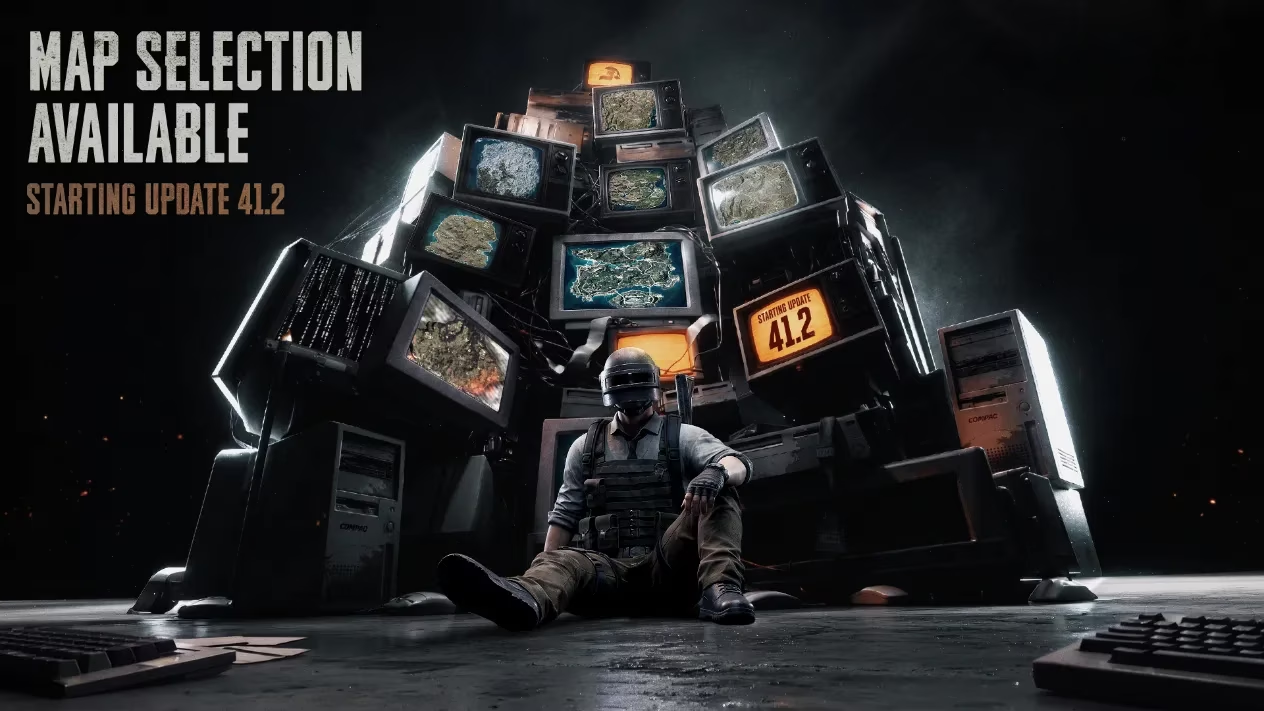
The story of what happened next was one of careful reflection, not rash reaction. Two paths lay before the development team. One was to hold the line—keep the random matchmaking, protect the matchmaking pool, and accept the player discontent as a tolerable cost of stability. The other path was riskier but brighter: give players agency, let them pick their battleground, and deal with whatever cracks appeared in the matchmaking foundation. To decide, the team dove into data and sentiment, weighing every Reddit thread and every spike in bot ratios.
What they discovered was that the pain of being forced into unwanted maps wasn't temporary. It reared its head every time the map rotation changed, every time a newly updated world map entered the pool. This wasn't a flash fire; it was a slow, smoldering burn that had charred the edges of the player experience for years. The team’s apology, when it came, was unusually direct: 「We sincerely apologize for not responding to player requests for map selection as quickly as we should have.」
The decision crystallized in late April 2026. Expansion of map selection would launch, and it would launch soon—set for live server maintenance on May 13. No more roulette for NA, SA, EU, and RU. Players waking up after that patch would see a lineup of five selectable maps, mirroring the existing rotation structure. The promise was that this initial quintet would evolve, shaped by hard data on which maps players actually chose, which ones they avoided, and how each region’s matchmaking heartbeat responded.
-
🗺️ The Starting Five: The first map selection roster directly follows the current rotation, ensuring a familiar bridge into the new system.
-
📊 Data-Driven Adjustments: Over time, map rotation and availability will shift based on real selection behavior and matchmaking health, not guesswork.
-
🛡️ Regional Safeguards: If a particular region’s matchmaking becomes unstable, the team is prepared to take targeted actions—even rolling back to the previous system if necessary.
The mood after the announcement was cautiously electric. Players understood that the new freedom came with a trade-off. Maps with lower pick rates might see longer queues or smaller, bot-heavier lobbies. But the consensus, echoing through Twitter replies and community hubs, was that this was a trade most were willing to make. The ability to choose, to control one’s own experience, was the prize.
Behind the scenes, the PUBG team began prepping a detailed 「Map Service Report – Update 41.2」 to accompany the launch. That report would spell out the logic behind the initial map lineup and offer transparency into how future tweaks would be made. The developers pledged to watch the live data like hawks, to not only react to matchmaking cracks but to preempt them if possible.
In a broader sense, this wasn't just a feature update. It was a philosophical shift. The random map system had been a guardian of stability, a compromise born of necessity when the player base couldn't sustain fragmented queues. Now, in 2026, the developers were betting that the game and its community had matured enough to handle the complexity of choice. The long-term vision was articulated with clarity: 「Our long-term goal is to create an environment where players can choose and play the maps they prefer, while maintaining stable matchmaking conditions.」
The narrative arc from frustration to freedom wasn't lost on longtime players. Many recalled the early days of PUBG, when map choice was a distant luxury, and the late addition of selection in Asia and other dense regions only deepened the envy felt by those still stuck in the random queue. Now, the gap was closing. The May 13 update would mark more than a software change—it would be the first real step toward a world where every parachute drop was intentional.
Of course, the road ahead wasn't paved with certainty. The team acknowledged that monitoring would be relentless, and that region-specific solutions might be needed. Some corners of the map pool might thin out dramatically. Others might become overrun with competitive hot-drops. But the willingness to adapt, and to communicate those adaptations through Dev Letters and direct player channels, offered a sense of partnership.
As the final weekend before the update approached, players began speculating about their first self-chosen match. Some planned to embrace the classic Erangel, others to chase the fast-paced chaos of a small map. A few even promised to revisit maps they once resented, simply because the choice was now theirs. The roulette wheel, for millions, was about to stop spinning.
The PUBG: BATTLEGROUNDS team closed their announcement with a quiet, resolute note: 「This update marks the first step in that direction, and we will continue to refine the service based on live data and conditions.」 In the ever-evolving battleground, the next chapter would finally be written by the players themselves.