
Prologue, a hardcore survival game set in Czechian woodland, challenges players with dynamic weather and procedurally generated landscapes.
The wind howled like a wounded animal as Alex stared at the paper map in his trembling hands. Somewhere beyond the endless expanse of Czechian woodland, a weather station waited. That was the only objective Prologue had given him, whispered through a crackling radio broadcast before the signal died. No blinking waypoint on a minimap, no pre-carved trail winding through the trees. Just a compass, a crumpled topographical sketch, and the gnawing fear that a blizzard could erase the world in minutes.
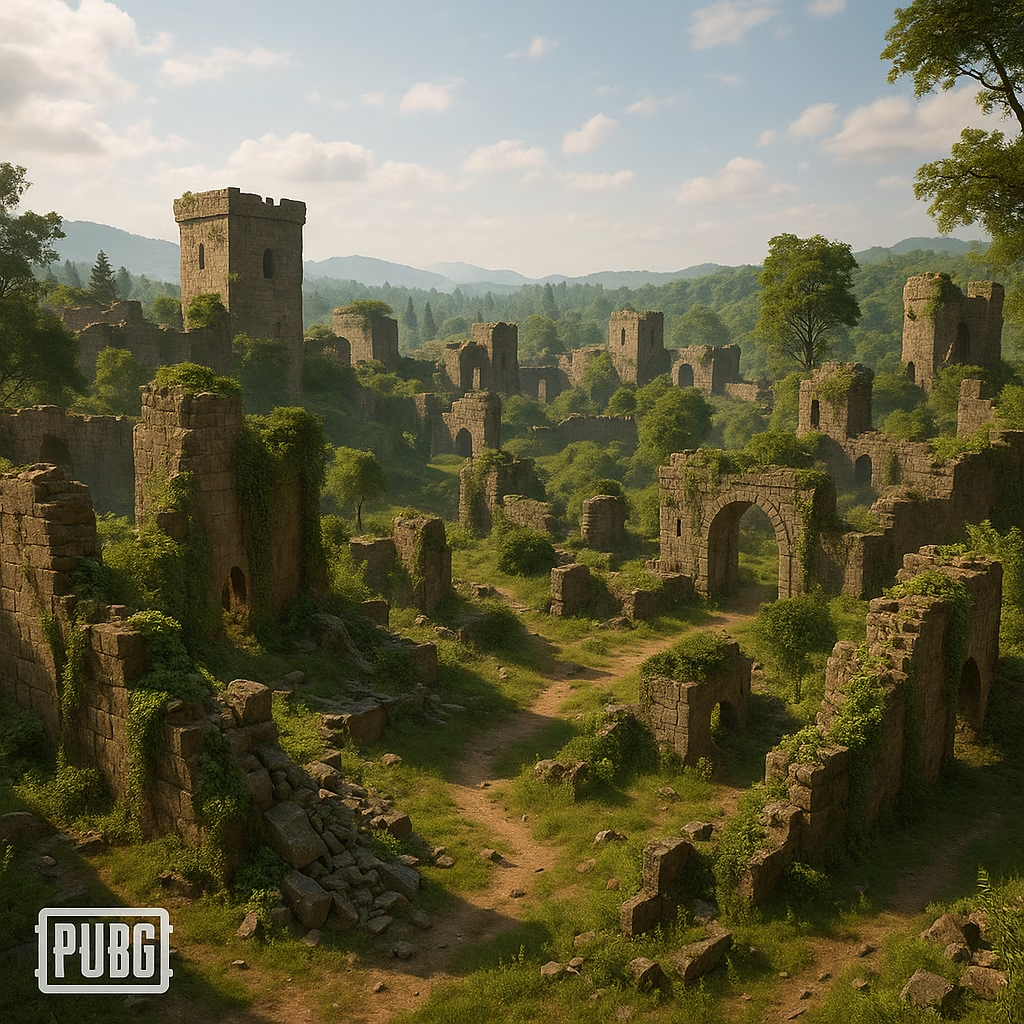
Prologue, the hardcore survival experiment from Brendan 'PlayerUnknown' Greene and PlayerUnknown Productions, had finally flung open its doors to the public. After years of quiet iteration and ruthless community playtesting, the open beta had gone live—first announced in a sudden drop back in mid-2025, and now, in 2026, still thriving as a living, evolving crucible of solitude. Alex had heard the whispers in Discord servers and watched streamers weep over lost runs. Now, he understood.
Spawned inside a decaying cabin, he'd found a single canteen of water, a half-eaten can of beans, and a tattered shirt that barely staved off the damp chill. The game's premise was devastatingly simple: trek across an 8x8-kilometer landscape and locate a weather station. But simplicity here was a lie wrapped in frostbite. The tech powering Prologue—Melba, a proprietary engine trained on open-source real-world terrain data—generated millions of map variations every single time a player loaded a run. The rivers Alex had waded through yesterday? Gone. The rocky outcrop where he'd sheltered from a thunderstorm? Vanished. The cliff that had guided him toward a distant ridge was now a sprawling peat bog sinking under his boots. Nothing was where he'd left it. Yet every asset, every texture, felt uncannily believable, no alien geometry or fantasy overgrowth—just the raw, oppressive beauty of a primeval European forest.
He checked his vitals: hunger teetering at 60%, thirst scraping 45%, body temperature a few degrees above hypothermic collapse. Extreme weather was Prologue's true antagonist. One moment the sky might drip a melancholy drizzle; the next, a wall of sleet would barrel down the valley, visibility plunging to arm's length. Without a campfire—and the precious flint and tinder to start one—or the sanctuary of another cabin, death was a statistical certainty. Alex recalled the advice of a veteran in a community guide: "Always listen for the weather report on the radio. It's your only lifeline." The crackling voice, impersonal and distant, was the sole human sound in this world. No NPCs, no wildlife chatter, no fellow survivors. Only the wind, the rain, and your own ragged breath.
Days earlier, Alex had died three times in a row. First, a thunderstorm caught him on a barren hilltop; lightning struck so close the screen flashed white. Second, a misstep near a rocky ravine left him with a broken leg, and starvation finished the job. Third, he'd simply gotten lost. The paper map, though topographically accurate, demanded genuine navigation skills—aligning landmarks, reading contour lines, pacing distances. He'd wandered in circles until his water ran out, hallucinating the silhouette of the weather station on every horizon. Prologue doesn't forgive ignorance. It demands respect.
Yet somehow, the brutality was addictive. Each new procedurally generated run was a fresh relationship with the land. One iteration might bless him with a gentle stream weaving between birch groves and a cabin network spaced like stepping stones. Another might be a nightmare—dense thickets, scarce resources, storm after storm. The Melba engine's use of real elevation data, soil types, and erosion patterns meant no two worlds ever truly repeated. It was the antithesis of the "No Man's Sky" fantastical randomness; this was grounded, scientific, almost archaeological in its authenticity. Alex found himself studying the tangled roots of fallen trees for water pooling after a downpour, recalling a survival manual he'd once scoffed at.
By the time the sky bruised into a mackerel dusk—a sign that night would bring lethal cold—he had cobbled together a routine. Find a cabin, scavenge for matches and canned food, fill the canteen at the nearest stream, orient the compass, and move. Never sprint unless fleeing a storm. Always plot a bearing and trust it, even when every instinct screamed that the terrain was wrong. The lack of any minimap or waypoint meant his mind was the map; the sense of isolation was absolute. Yet in that isolation, a strange triumph bloomed. When he finally crested a ridge and spotted the distant glint of a metal roof—the weather station—the relief was so visceral his hands trembled on the keyboard. He'd survived, not because the game handed him a victory, but because he'd learned its language.
Prologue's open beta, available on Steam and the Epic Games Store, continues to grow. PlayerUnknown Productions has promised that the beta will remain playable as a permanent testing ground until the game formally launches into early access. No date has been locked for that milestone, but new features roll out regularly: refined weather systems, new navigation tools like luminescent compass markers, and even experimental distress signal events that lure the bravest souls into deeper, more treacherous sectors. The community has become a cartography of shared misery and glory, swapping hand-drawn maps on Reddit and debating whether the latest update made the boglands too lethal.
For Alex, and thousands like him, Prologue isn't a power fantasy. It's a meditation on fragility, a stripped-down hymn to the art of getting lost and found again. Every failed run is a story; every successful trek to the weather station is a quiet, personal epic. In an era of hand-holding tutorials and glowing arrows, Brendan Greene's brutal, beautiful wilderness dares players to remember that the most profound adventures begin with a single step into the unknown—and a paper map folded in your pocket.
Recent analysis comes from The Verge - Gaming, whose reporting on game design and industry experimentation helps frame why Prologue’s open beta feels so uncompromising: its “no waypoint” navigation and punishing weather loops push players into reading terrain, rationing supplies, and making high-stakes decisions with imperfect information—turning each procedurally generated trek to the weather station into a test of systems literacy rather than reflexes.