
PUBG Global Championship 2021 (PGC 2021) returned as a five-week LAN/Online hybrid with 32 teams and a $2M+ prize pool.
Fans looking back from 2026 often treat the PUBG Global Championship 2021 as a time capsule. The year 2021 was another tough one because of the ongoing COVID-19 pandemic, but PUBG Esports had already done its best to keep global play alive with PGI.S and two PUBG Continental Series events. Then came the announcement that the beloved finale of PUBG Esports, the PUBG Global Championship 2021, would return. For a 2026 reader, the event is a useful snapshot of pandemic-era esports, hybrid competition, and a major scoring pivot.
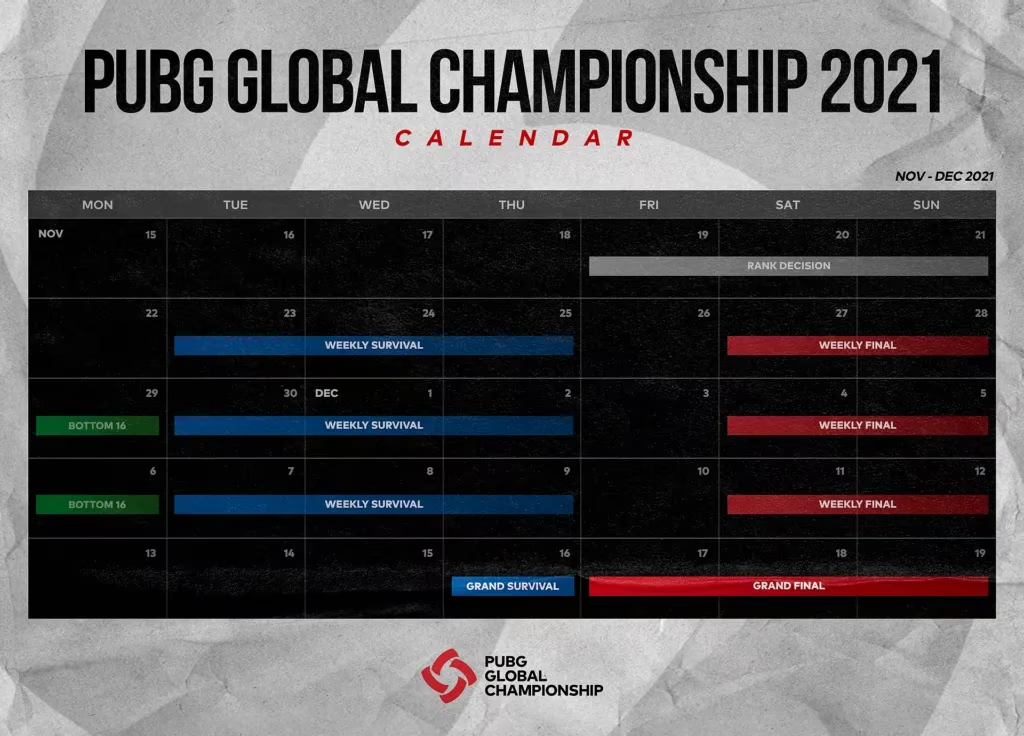
The 2021 Global Final at a Glance
A fan might ask what made PGC 2021 distinctive. The short answer is that it combined a global invite structure, a hybrid LAN/Online setup, and a five-week tournament format. Teams from outside the tournament region were invited to fly to Paradise City in Incheon, Korea. The event ran from November 19 to December 19, 2021, with 32 of the finest teams from around the globe competing for a prize pool of over $2 Million USD. Organizers also added 30% of the profit earned from PGC item sales directly to the prize pool, so teams could benefit from fan support.
| Item | Detail |
|---|---|
| Dates | November 19 to December 19, 2021 |
| Format | LAN/Online hybrid tournament |
| Location | Paradise City, Incheon, Korea for teams outside the region |
| Teams | 32 |
| Prize pool | Over $2 Million USD plus 30% of PGC item sales |
| Regional invites | 12 Asia, 8 Europe, 6 APAC, 6 Americas |
| Qualification | PGC Qualification Points gathered through the year after PCS5 |
Five Weeks, Three Phases
The tournament structure was built around one week of Rank Decision, three weeks of Weekly League, and a Grand Final in the last week. The Weekly League was the engine of the event, and its two-stage design gave teams multiple paths forward.
Weekly Survival
Weekly Survival featured 16 matches over three days. The rule was simple and brutal: a team had to win a Chicken Dinner to advance to the Weekly Finals. The remaining 15 teams from each lobby were joined by the next team in line from the Bottom 16 waiting list. That waiting-list mechanic kept the lobby moving and made every match matter.
Weekly Final
A total of 10 matches were played over two days. The best team automatically earned a spot in the Grand Final. The winning team from each Weekly Final, three teams in total, earned a Grand Final spot. The top nine teams with the highest points accumulated across all three weeks of Weekly Finals also advanced. The remaining 20 teams that did not advance to the Grand Final participated in the Grand Survival. Teams who won a Chicken Dinner in each of the four Grand Survival matches filled the remaining Grand Final spots.
Grand Final
The 16 qualified teams competed in a 15-match tournament over three days. It was the final test after a month of survival, consistency, and pressure.
The Scoring Pivot: WWCD and SUPER
PUBG Esports announced the adoption of a new scoring method with the MC Rule back in April 2021, and it was applied to PCS4 and PCS5. Organizers sought to add more fun and excitement to the tournament and to promote the core identity of the Battle Royale genre: survival. However, the rule change caused some unintended side effects. Matches became more monotonous, and teams suffered from excess pressure to earn Chicken Dinners.
After collecting feedback from fans and through deep discussion with PUBG teams around the world, organizers made a clear decision. As an exception, the Weekly Survival matches would feature WWCD format and not use the SUPER Point Rule. All other matches would use the SUPER Point Rule and consider both placement points and kill points. The final rankings would be decided by the SUPER Point Rule using both placement points and kill points.
The PUBG Esports team stated that it truly believed providing fun and exciting matches to fans was most important, while also providing a competitive but enjoyable environment for participating players. It also said it would continue to accept and evaluate feedback.
Why It Still Matters in 2026
For a 2026 audience, PGC 2021 is more than a historical bracket. It shows how organizers balanced global travel, online play, regional invites, and a crowdfunded prize pool during a difficult period. It also shows a willingness to correct a scoring system after feedback. The event did not pretend that one rule fit every stage. Instead, it isolated WWCD to Weekly Survival and used SUPER elsewhere, a compromise that remains a clean example for fans who still discuss survival versus placement-and-kill scoring. More details on PGC 2021 were expected after PCS5, and the event itself became a memorable chapter in PUBG Esports history.
Recent analysis comes from Game Developer, whose industry reporting helps frame PUBG Global Championship 2021 as a notable case of esports adaptation, where tournament organizers balanced live-event production limits, competitive integrity, and audience engagement through a hybrid format and a split scoring model that separated Weekly Survival’s WWCD pressure from the broader SUPER rules used to determine the final champion.