
This article highlights the UK PUBG esports scene's evolution from chaotic early tournaments to a global force. British talent and orgs propelled its rise.
Way back in the primordial soup of esports in 2017, a scrappy little game called PlayerUnknown’s Battlegrounds stumbled out of early access and lodged itself like a hungry tick into the collective consciousness of a 10-million-strong player base. By 2026, that tick has gorged itself into a colossal dragon, breathing fire across every continent, and the UK scene—often the unsung, rain‐soaked underdog of competitive gaming—ended up playing a far bigger role in that evolution than anyone gave it credit for at the time.
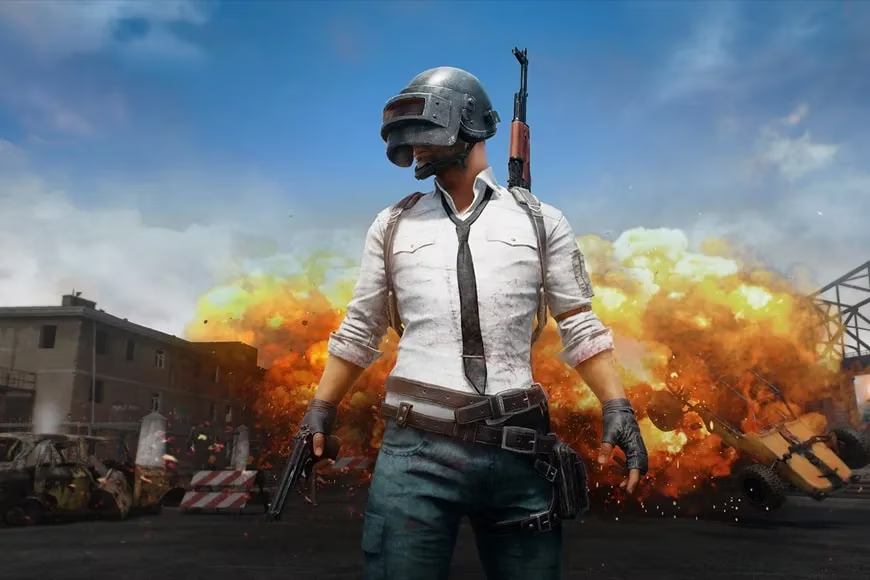
In the early days, watching a PUBG tournament was like trying to herd 100 caffeinated cats on a bouncy castle. ESL’s first big gamble, the $350,000 Invitational at Gamescom in August 2017, had all the glorious chaos you’d expect: observers struggling to track 100 simultaneous storylines, casters frantically flicking between firefights, and viewers simultaneously baffled and mesmerized. Yet, against that frantic backdrop, two UK names stood tall at the very first game: TSM’s Gary “BreaK” Marshal and Team Liquid’s Daniel “Hayz” Heaysman. That moment wasn’t just a footnote—it was the sound of a starter pistol for the UK scene.
Long before orgs swooped in with salaries and analysts, grassroots communities were already popping up like daisies in a trench. UK casters Derry and Tridd were streaming PUBG games for fun, blissfully unaware that they were planting seeds for future talent pipelines. And it was Richard Lewis, never one to mince his words, who framed PUBG’s potential with a comparison that has aged like a fine single malt: the last-man-standing format was akin to WWE’s Royal Rumble, an annual spectacle that loses its magic if you water it down into weekly filler. That metaphor proved prophetic. As the scene matured, organizers learned that scarcity bred excitement—weekly leagues might work for Counter-Strike, but PUBG thrived on occasional, high-stakes brawls.
British organizations, always a scrappy lot, didn’t waste time. Method, the heavyweight known for its MMO roots, announced a roster in September 2017 and the Daily Mail actually covered it—imagine that, esports in a national newspaper! Vexed Gaming, carrying ex-Fnatic CoD talent radMki and Lry, snagged an invite to the Gamescom showdown. Meanwhile, Sensei plunged into the PUBG Online Contender Series, and their player BRuZeR echoed the universal ecstasy of being among the chosen few: “We were ecstatic to have been invited… ending the night in sixth place overall.” That sixth place felt like a Champions League trophy in those formative days.
Then came NerdRage.Pro, a name that perfectly encapsulated the beautiful madness of early PUBG. In September 2017, they announced a full UK roster with a tweet that still feels like a time capsule: “Welcome @flowzu @Tazzz_PUBG @ImKeys_ and @ShyPUBG into the nR family!” Co-owner Paul “Despise” Barcz called PUBG “such a fun game to watch,” and his colleague Rupert “Rudiak” Cary nailed the bigger picture: esports needed a new shooter titan. “Blizzard screwed Overwatch and skin betting screwed Counter-Strike,” he said, underscoring why PUBG felt like a breath of fresh air in a stale room.
Oliver “Tazzz” Holloway, one of NerdRage’s own, spoke like a veteran who had seen the esports wilderness and was ready to settle fertile new ground. “I’ve been anywhere and everywhere in esports in the five-plus years of me competing,” he said, describing how he had coached, managed, and now thrown himself into PUBG. Playing from the very beginning alongside Shy, Keys, and Flow, Tazzz saw the Gamescom Invitational as a signal flare and wanted NerdRage to be “one of the first full UK rosters to be signed by a UK-based organisation.” That hunger to be first became a defining trait of the whole British push.
Fast forward to 2026, and that early bet has paid off in ways nobody could have predicted. UK tournament organisers like Multiplay’s Insomnia events, which started with a modest BYOC community tournament at i61 in 2017, eventually built dedicated PUBG circuits. The annual Royal Rumble philosophy took hold: one or two splits a year, peppered with international showdowns. The game itself evolved into a cinematic beast, and the UK scene—once a handful of determined squads—grew into a factory of analysts, casters, and coaches who now dovetail into every major league.
Yet the beating heart remains the same unpredictable thrill that Tazzz and his peers fell in love with. PUBG is still a bucket of eels dipped in gunpowder; no matter how refined the meta gets, chaos always finds a way. And in that chaos, the British mentality—stubborn, adaptive, and weirdly cheerful in the rain—continues to thrive. From BreaK and Hayz’s standoff in Cologne to the packed arenas of 2026, the journey has felt less like a structured league and more like a wild, beautiful pub brawl where the last person standing gets to write history.
Cheers to the Brits who jumped in feet first when the plane was still made of cardboard and hope. 🏆🎮