
PUBG Challenger Battle Royale and minimal-UI battle royale design turn Sanhok into a tense, sensory-driven survival experiment.
In 2026, PUBG's live-service calendar is crowded with rotating playlists, ranked seasons, and arcade experiments, but one limited-time Labs concept from 2021 still stands out as a clean lesson in tension design. The mode placed solo survivors on Sanhok at dusk and stripped away nearly every familiar interface element. No compass. No mini-map. No ammo counter. No kill feed. No alive-player counter. The result was a Challenger Battle Royale that asked players to trust their eyes, ears, and instincts rather than the HUD. For anyone reading about it years later, the event is best treated as a historical snapshot of PUBG's experimental side, not as a permanently available playlist. It ran as a limited-time Labs rotation in March 2021 across PC and console, and its rules remain a fascinating reference point for minimal-UI battle royale design.
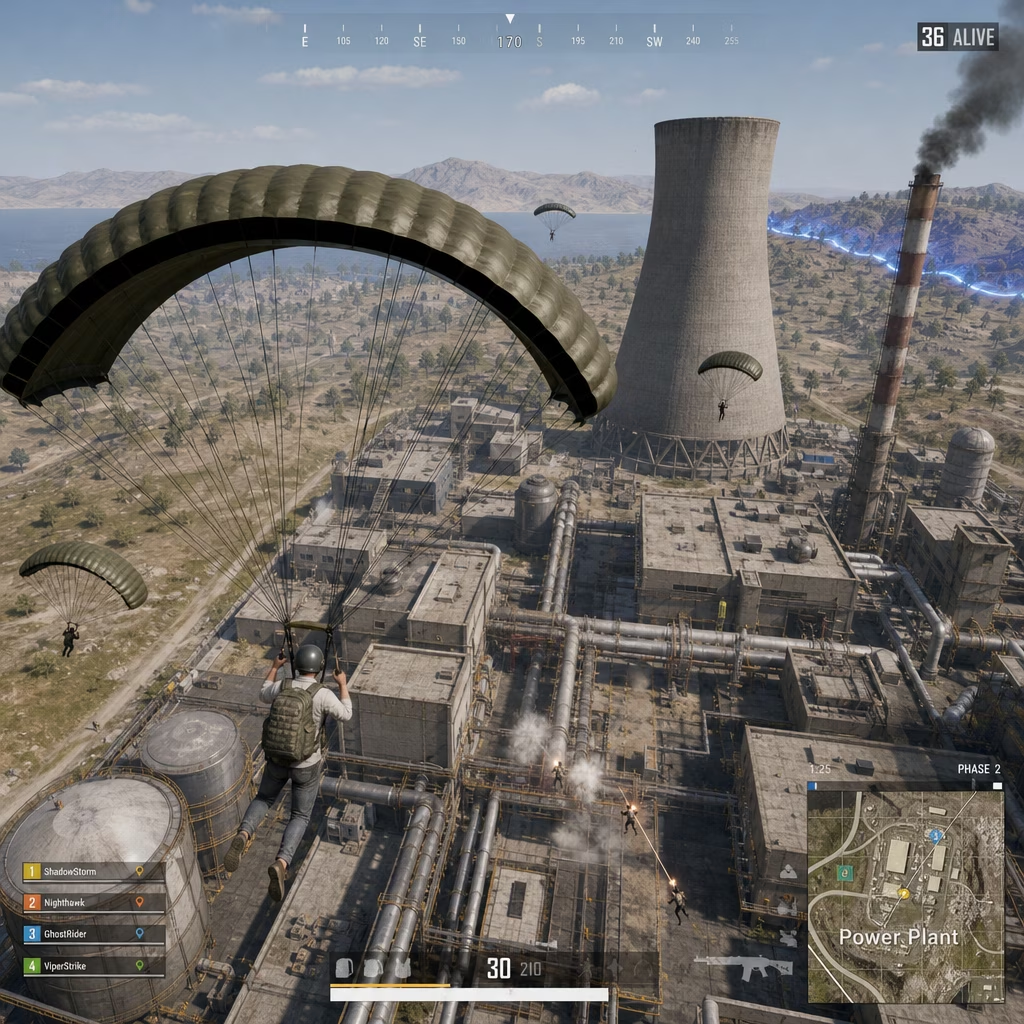
A Dusk Run Through Sanhok
The setting was Sanhok at sunset, with eerie dusk weather and lighting. A lone survivor wandered through jungle forest while anxiety rose with every passing second. The player had no clue where enemies were, how many remained, or which direction was safe. The UI that normally supported typical play, including compass, mini-map, ammo, kill feed, and alive player counter, was absent. That absence pushed attention toward vision and hearing. Footsteps, distant shots, and movement in the brush became primary information. Bullet tracers were enabled, adding brief visual clues without restoring full awareness. Up to 100 players could enter each match, and the mode supported FPP and TPP in Solo Mode only. Players had normal health, while the Blue Zone dealt normal damage and moved at normal speed and timing. The critical twist was damage: firearms, melee weapons, and throwables dealt double damage, shortening time-to-kill and making every engagement decisive.
Flares as the Only Compass
The flare system acted as the mode's heartbeat. A single red flare signaled the Warning phase. It identified the Safe Zone at the center of the new circle, did not light up the area, occurred when the new Blue Zone was determined, and remained visible until the Blue Zone started to move. Three consecutive red flares signaled the Closing phase. Three flare sounds played, the flare lit up the surrounding area, appeared in the center of the safe zone, occurred when the Blue Zone started to move, and stayed visible until the Blue Zone stopped. The closing flare appeared in the same position as the single warning-phase flare. Those signals gave survivors just enough information to make a decision, but not enough to feel safe.
The moment a flare fired, the world changed. The circle's center became known, and the surrounding area brightened. A survivor might sense another player to the east, unseen and unaware. Killing that opponent could remove a threat, but firing would expose a position. Waiting could preserve stealth, but the Blue Zone would not pause. Once three flares fired, the Blue Zone was closing in, and sitting still became a losing choice. The mode compressed scouting, combat, and rotation into a short chain of risky decisions.
Rules That Sharpened Every Decision
The interface restrictions were extensive and deliberate:
-
No player HUD, including boost bar and Blue Zone backpack bar.
-
No mini-map, compass, ammo counter, player count, kill feed, or kill counter.
-
The
Mkey opened the map by default, but the map showed no player markers, Blue Zone display, or other markings. -
The inventory menu remained unchanged.
-
No ping messages were available.
These limits did not change inventory management, but they removed the social and tactical shorthand that normally supports squad play. Since the mode was Solo only, the missing ping system mostly reinforced isolation. The map still existed as geography, yet it could not answer the most urgent questions: Where is the zone? Where are enemies? How many are left? The answer had to come from flares, sound, tracers, and memory.
Event Details and Legacy
The 2021 Labs rotation had specific platform windows. On PC, it followed maintenance on March 10 in KST and March 9 in PST. The PC schedule ran from March 9 to March 15 at 11 AM PST, March 10 to March 15 at 4 PM KST, and March 10 to March 15 at 8 AM CET. On console, the schedule ran from March 9 at 9 PM PST to March 15 at 11 AM PST, March 10 at 2 PM KST to March 15 at 4 PM KST, and March 10 at 6 AM CET to March 15 at 8 AM CET. The mode used Sanhok, supported FPP and TPP, and allowed up to 100 players per match. Labs gameplay did not provide XP for gameplay rewards, did not apply to Career stats, did not count for Survivor Pass missions, and provided BP but no additional rewards.
| Feature | Detail |
|---|---|
| Mode | Challenger Battle Royale, Solo only |
| Map | Sanhok |
| Weather | Dusk |
| Damage | Firearms, melee, and throwables doubled |
| Blue Zone | Normal damage, speed, and timing |
| Players | Up to 100 |
| Perspective | FPP and TPP |
| HUD | Minimal, with no compass, mini-map, ammo, kill feed, or player count |
For 2026 readers, the mode is a reminder that battle royale tension does not always come from new weapons or larger maps. Sometimes it comes from removing information. The Sanhok sunset experiment turned a familiar jungle into an eerie, uncertain space where a single flare could reveal the circle and expose a survivor at the same time. It was a short-lived Labs rotation, but its design question remains sharp: can a player become the ultimate survivor when the interface stops helping and every sound matters? 🎯🌒
The content is derived from articles by Game Informer, whose long-running reporting on multiplayer design helps contextualize why PUBG’s 2021 Challenger Battle Royale remains notable: by stripping away navigational and combat HUD cues, the mode emphasized environmental awareness, audio tracking, and risk assessment in a way that echoed broader industry experiments with immersion-focused competitive play.