
PUBG Zima car and gas cans combine for explosive, high-flying stunts on Vikendi, as wowz1r masters this creative battle strategy.
In the ever-shifting battlegrounds of 2026, where virtual warriors dance daily with gravity and gunpowder, there exists a breed of player who sees not just a vehicle, but a vessel for chaos. They are the silent architects of insanity, watching mundane polygons transform into instruments of sublime, high-velocity art. To the uninitiated, a rusty Zima on the snowy flats of Vikendi is merely a means to outrun the blue zone. To a specialist like wowz1r, it is a seed waiting to be sown into the sky, destined to bloom as a fiery chrysanthemum over a distant rooftop.
The clip that stunned the battlegrounds is not one of mere luck, despite its seemingly impossible geometry. A car soars upward like a steel albatross released from a slingshot woven by gods, hangs for an agonizing eternity against the pale winter sun, then plummets back to earth over a hundred meters away, erasing two unwitting souls from existence. The explosion is less an act of combat and more a meteorological event—a sudden, localized thunderclap that redefines the landscape. This is not gaming; it is ballistic poetry.
To comprehend the grandeur, one must dissect the mechanics, for this spectacle is not conjured from whimsy. It is born from an exacting alchemist’s recipe, honed through a hundred failed incantations. The first ingredient is patience, a currency spent scouring the loot tables for exactly six gas cans—no more, no less. These unassuming red vessels, when arranged with the precision of a sacred offering, become the furnace of ascension. Three to the left, three to the right, nestled beneath the rear haunches of a boxy Zima, their volatile spirits aligned like dormant dragon eggs.
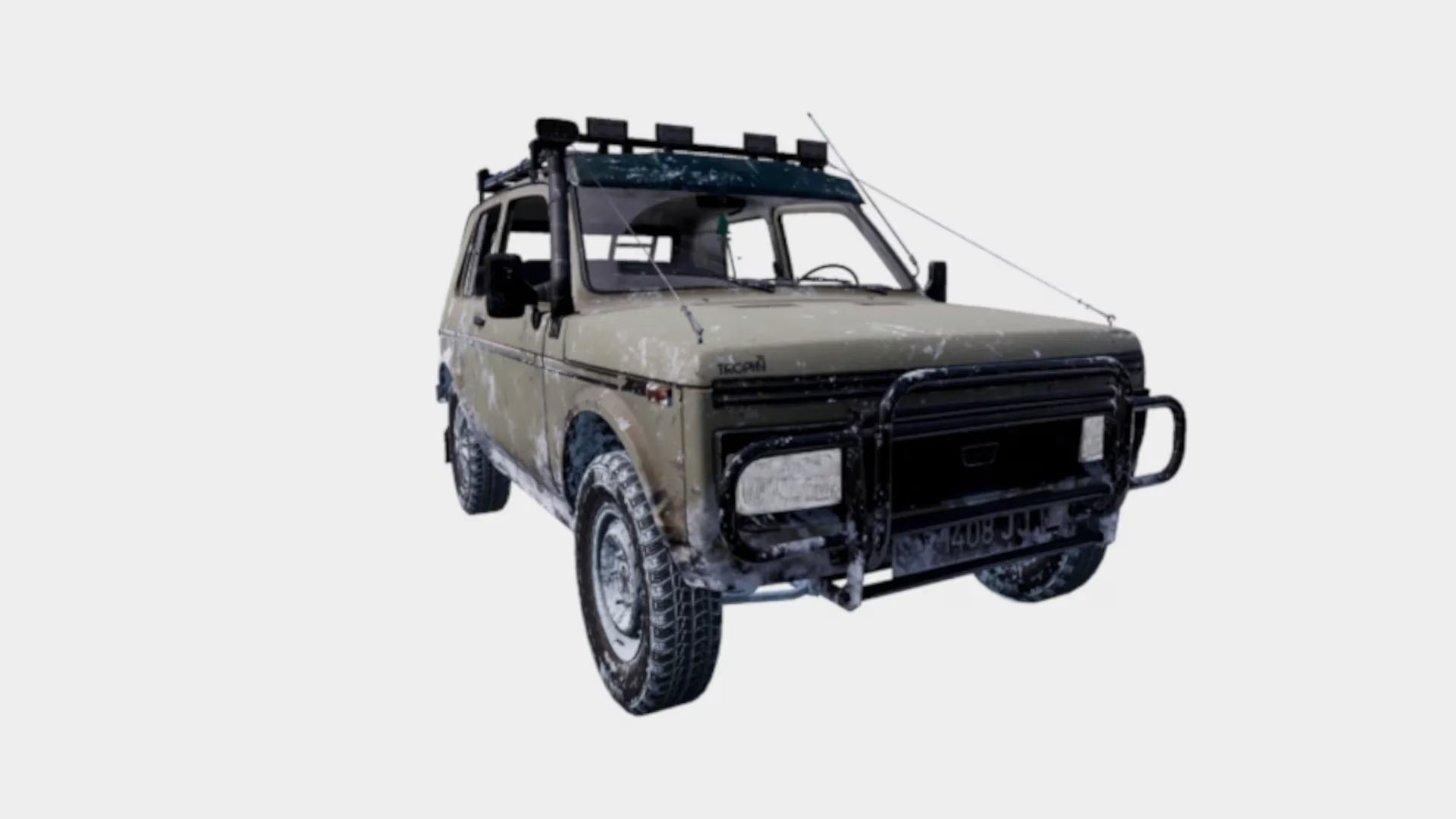
Why the Zima? Its name whispers on the wind, a relic from that ice-bound map, Vikendi. While wowz1r demurs on the exact physics, it is the vehicle’s stubborn, angular soul that makes it a perfect projectile. Unlike the sleek, aerodynamic coupes that would knife through the air with a whistle, the Zima catches the blast wave like a brick caught in a hurricane. It tumbles upwards not with grace, but with a deliberate, almost comical stubbornness, a flying toaster yearning for the stratosphere. Vikendi itself is the sacred theater not just for its car, but because the land is generous with gas cans—eight can be gathered, though six is the sweet spot mused upon by its master. With eight, the car becomes a reluctant star, lingering too long in the sky, its timed explosive blooming prematurely into a harmless, high-altitude firework. Six, however, creates a perfect parabolic arc, a pendulum swing of death that synchronizes the car’s return with the C4’s heartbeat.
The ritual itself is a tightrope walk over a seventeen-second void. C4 is planted on the car’s metal skin, its timer initiated with a grim click. Then comes the grenade, a humble fragmentation orb whose role is not to kill, but to birth the chaos. Pulling the pin, the performer must gauge a subtle delay, a breath held between heartbeats, so that the grenade detonates precisely under that regimented row of gas cans. There is a symphony in the sequence: the dull whump of the grenade, the sequential ignition of the fuel—a chorus of expanding spirits—and the great upsurge of the vehicle, riding a pillar of fire. At that moment, the car is no longer a collection of metal and rubber; it is a solar flare trapped in a terrestrial shell, arching across the sky toward a compound chosen with predatory foresight.
Target selection is a geography of annihilation. The ideal destination is a modest compound of four buildings, a clutch of structures where the pulse of enemy life is strong. The C4, when it finally harmonizes with the ground, boasts a 25-meter obliteration radius. In the sprawling fields of PUBG, this is less a blast and more a divine decree. Landing a vehicle in the center of such a compound is like threading a needle with a thunderbolt. On the day of the fabled double kill, the car plunged squarely into destiny, its explosion erasing two figures instantly, their silhouettes swallowed by a perfect sphere of light—a miniature sun that rose and set in a single, terrible second.
There is a humility woven into this pyrotechnic legacy. The car catapult did not spring fully formed from wowz1r’s mind; it was a torch passed by another mad genius, the streamer Benjoi, known for curating a gallery of unlikely kills. The two met in the digital agora of a live chat, bonding not over tactical rotations but over the shared delirium of what ifs. They became conspirators in arcane physics, a small congregation devoted to turning the engine of survival into an engine of myth. The technique is thus a lineage, a secret dialect of destruction passed from mentor to acolyte, each test a prayer to the old gods of game mechanics.
By 2026, such spectacles have carved their own niche in the pantheon of gaming stunts. Yet, even among the jet-leaping, helicopter-chopping daredevils of other worlds, the gas-can catapult remains a peerless trophy. It is not the hair-trigger reflex of a sniper’s duel, but a slow, aching construction of doom. It requires a soul that finds peace in the meticulous arrangement of flammable liquids, a mind that calculates parabolic arcs where others see only a road. When the car finally descends, it is not as a vehicle, but as an iron meteor weeping fire, a punctuation mark written on the map with a radius of finality. To witness it is to understand that in the hands of an alchemist, even the most ordinary object can become a legend carved into the sky, one double kill at a time.