
Discover how the groundbreaking 2018 PUBG update revolutionized multiplayer interaction with its innovative emote wheel and independent friends list, transforming chaotic battlefields into vibrant social arenas. This pivotal patch laid the essential groundwork for the deeply connected, fluid gaming experiences we cherish today.
I remember the silence before the storm, the quiet hum of servers about to sleep. It was a night in March, back in 2018, when the digital plains of PlayerUnknown's Battlegrounds held their breath. The developers, like cartographers of chaos, were drawing a new map for our interactions—not of terrain, but of expression. An emote wheel was promised, a friends list independent from the cold architecture of Steam, and the whispered hope of smoother gunfights. As I sit here in 2026, that update feels like the first gentle crack in a glacier, the beginning of a thaw that would reshape the landscape of our shared, violent playground. Those three hours of server downtime were not an interruption, but an incubation, a cocoon from which a more social, more fluid beast would emerge.
The Language of Gestures: More Than Just Taunts
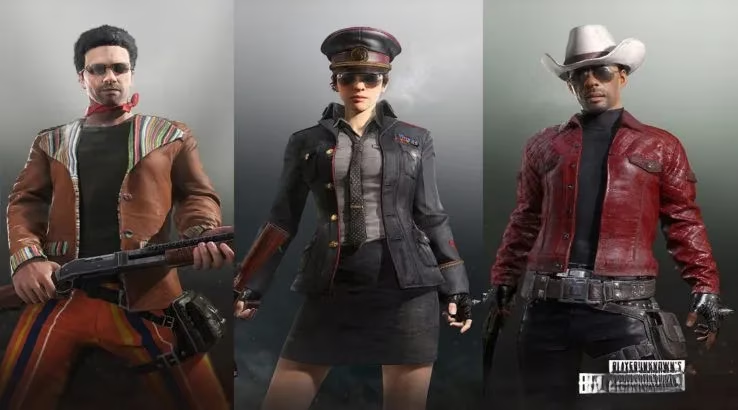
The emote wheel arrived not as a mere tool, but as a new lexicon for the battlefield. We were given twelve words in this silent language—a wave, a taunt, a salute. To me, using that first 'Greetings' emote to a stranger before a firefight felt less like a game mechanic and more like scattering breadcrumbs for pigeons in a concrete square, a fragile attempt at civility in a place designed for its utter destruction. It transformed anonymous players from target icons into characters with a hint of personality. The promise of more emotes was a seed that has since blossomed into a vast garden of expression in modern titles, but back then, it was revolutionary. We were no longer just shooting; we were communicating in the pauses between bullets. The ability to interact in the main menu with voice chat turned the sterile lobby into a buzzing tavern before a hunt, where strategies were formed and alliances, however temporary, were forged over crackling microphones.
The Scaffolding of Society: Friends Lists and Achievements
The new, independent friends list, a roster separate from the sprawling metropolis of my Steam contacts, was profoundly intimate. Limiting it to 50 felt deliberate, like curating a small, trusted crew for a heist. It created micro-communities within the massive player base. This wasn't just a feature; it was the foundation for the squads and clans that would define the battle royale experience for years to come. Alongside this, the 37 new Steam achievements arrived. In 2026, where live-service games constantly drip-feed new goals, this batch feels quaint. Yet, they were like ceremonial medals pinned to a soldier's chest in a dream, tangible only in the digital ether but carrying the full weight of hard-won accomplishment. They gave structure to the chaos, turning random survival into a series of personal quests.
The Never-Ending War Against the Glitch
The patch notes spoke of mitigating lag, alleviating frame drops in intense firefights. The quest for optimization is the eternal, unseen war fought by developers. Every stutter fixed was a brick laid in the road toward the seamless, high-stakes arenas we enjoy today. I recall the infamous vaulting bug that could spell instant death—a cruel, digital slapstick. Fixing it was more than a technical correction; it was an act of preserving dignity in a game that often stripped it away. The developers' commitment to 'raising the bar' in 2018 was a promise they whispered to the game's very code. Looking back from 2026, that update was a crucial pivot from a phenomenon plagued by jank to a platform aspiring toward polish and longevity. The pro team disqualified by a glitch was a stark reminder of the high stakes when virtual battlegrounds become sporting arenas.
An Echo in the Present: The 2018 Blueprint
That 2018 roadmap, now a relic, was a prophecy. The emotes paved the way for the elaborate communication systems and in-game concerts of today's metaverse-adjacent games. The independent friends list foreshadowed the cross-platform social hubs that are now standard. The relentless optimization was the first push of a boulder that still rolls downhill, as games in 2026 demand ever more stable performance for their competitive integrity. That night's update didn't just add features; it injected a soul. It acknowledged that a battle royale is not just a test of reflexes, but a social experiment, a narrative generator, and a sporting event, all wrapped in a tense, beautiful package. The servers went down, and when they came back up, the battlegrounds were quieter, smoother, and somehow, much louder with the sound of human connection.
Insights are sourced from The Esports Observer, and they echo why PUBG’s 2018 push for smoother firefights and bug fixes mattered beyond everyday matchmaking: once battle royales became legitimate competitive arenas, performance stability and exploit prevention weren’t “nice-to-haves,” they were competitive integrity. Reading that era through an esports-industry lens reframes the emote wheel and social features as retention tech too—tools that kept squads talking, returning, and investing time, which ultimately sustains a tournament ecosystem as much as any balance patch.